Saturday, September 22, 2012

Glowing Light: Venice

The first of three secondary colors, ARANCIONE, or orange, is a mixture of the primary colors red and yellow.  Fire, embers, sunset, citrus, coral...

Marzapane: a confection with a distinct almond flavor, made of sugar, honey and almond meal.

Coral jewels.

I have shown you designs from Venice's Mariano Fortuny before.  He is becoming my Venetian muse.  He lived from 1871-1949 and was a prolific painter, etcher, sculptor, photographer, architect and inventor.  His life culminated with his renowned textile designs, most famous of which was the Delphos Gown, made of shimmering, crimped, silk (like the scarf above) that hugged the wearer's form (a shocking change from Victorian corsets).  It was said the garment's fabric was light enough to be drawn through a wedding ring.  I saw an original turquoise Delphos Gown at an antique fair last weekend for €400!

Another Fortuny design (a far cry from a sow's ear...).

Architecture and undies - so Italian!  Look closely, and reflected next to her left hip is a nun, covered from head to toe.

I've always wondered why people with orange hair are called redheads.

In my last, BLU post, I spoke of the famous, five-generation Rubelli textile company, housed in a Renaissance palazzo.  Here is a fellow artist from the Scuola Internazionale di Grafica,  choosing one of the contemporary samples that range from €40 to €3,000 per meter.  

The famous British artist, Turner, was known for his ethereal, light-filled paintings.  Between the years of 1833 and 1846, paintings of Venice constituted 1/3 of his body of work.  It is said he stayed in a hotel overlooking Piazza San Marco, and went up to the rooftop to sketch during dawn and dusk.  This evening photo of the sky over Campo Santo Stephano, after a glorious thunderstorm, reminds me of Turner's work.

An interesting lamp of flames.

Looking straight up at the Teatro La Fenice's chandelier.

Chandeliers hanging in the furnace room of the Seguso glassworks in Murano.

When I first arrived in Venice, I felt artistically uninspired.  While speaking with Matilde, the founder of the Scuola di Grafica, she said she had a respected art professor in Rome who said:  "Art is like a cat.  When you want it to sit on your lap, it won't.  But, when you least expect it, it jumps up on your lap and curls up, allowing you to do anything to it."  So I began with some simple color studies, like this one.

Then, Matilde showed me the loosening-up process of sitting before a mirror, with your paper up against your chest, and painting while looking at the paper in the mirror, not looking at the paper directly.  It taxes both sides of the brain, and unexpected parts of your character emerge.

I then photocopied these "mirror" paintings and did a glue-transfer process onto various papers or canvases.  Mysterious "psyches" continued to reveal themselves.

For some reason, much of my time in Venice has been a reflection on aging.  This one, in particular, intensely captures the depths of feelings I'm facing about my age.

A lovingly cared for shrine.

The antique fair, where I saw the €400 Fortuny dress, was set up for 3 days in the square right in front of my apartment.  It had a fantastic array of Venetian, European and Asian items, including this Buddha.

I took a day trip to the island of Burano, a fishing village known for the bright colors of its houses.  It was truly enchanting.

Another view of Burano.

I am entranced by Venetian chimneys.  It always seems they come in families, with genealogical resemblances to their neighbors, but still every one different. 

Real foliage and metal foliage.

This is a hand wrought iron bracket on the historic well of a private palazzo.

As portrayed in Shakespeare's Merchant of Venice, this is in Venice's historic Ghetto.  The English word, ghetto, is borrowed from the Venetian word, ghèto, which means foundry.  This isolated part of Venice was a cannon foundry before the influx of Jewish citizens, fleeing persecution.  The Jews were housed in an area surrounded by water and controlled at night by heavy gates, manned by Christian guards, both protecting and segregating its inhabitants.  Due to the cramped quarters, additional floors were added to the tops of the buildings, making them some of the tallest in Venice.  Laws forbid building separate synagogues, so they were built on the top floors (like the wooden one in this picture) so that there should be no obstructions between the congregation and the heavens. 

An orange pigeon at Piazza San Marco.

I've mentioned the cruise ship controversy in Venice, and I think this makes the issue clear.  On this day, a huge demonstration was staged against the allowance of cruise ships into Venice's lagoon.  Police boats and helicopters were everywhere as demonstrators in small boats yelled and shot off smoke bombs, to little avail, being completely dwarfed by the ships that were being towed out to sea.  San Giorgio Maggiore, looking very small, is in the background. 

 Up next, the second secondary color, VIOLA!


Saturday, September 15, 2012

Venice got the blues...

With this post, we'll say arrivederci to the three primary colors:
ROSSO, GIALLO and BLU

Literally within minutes, the weather in Venice can go from sunny and clear, to whipping wind, lightning and horizontal hail. 

To the right,  the church of Santa Maria della Salute (health), to the left, the church of Santa Crociera del Svago (cruise of leisure).

The beautiful Fondamenta Zattere as seen from the bow of a vaporetto.

When not out on the water, in the middle of a large campo (square), or sipping a spritz on your rooftop terrace, this is a typical blue sky view.

A roofscape, framed by a window in the palazzo of the Fortuny Museum.

The canals, as polluted as they are claimed to be, still glow this exquisite clear, blue-green.

A brooding sky over the Basilica di San Marco.

The Ponte dei Sospiri (Bridge of Sighs) was built in 1602 and connects the prison to the interrogation rooms of the Doge's Palace.  The view from the Bridge of Sighs was the last view of Venice that convicts saw before their imprisonment.

This statue, on a geographically prominent point, is situated at what once was Venice's Sea Customs Post.  Now the building displays modern art from the collection of Francois Pinault, a wealthy French entrepreneur.  In 2008, when the building was turned into gallery space, the designer was the famous architect, Tadao Ando.  Across the Canal Grande, you can see the bell tower on Piazza San Marco.

When not in use, the gondolas are covered in blue canvas.
A group of us took a private tour of the showroom of the renowned historic Rubelli fabric company, located in a palazzo on the Grand Canal.  Here are exhibited two chairs from the 1930's, upholstered in Rubelli fabric from that era.

As interesting as the historic fabrics at the Rubelli showroom were, the architecture of the palazzo itself was equally stunning.  I looked up and saw this blue and gold ceiling...

...and this ornamented and gilded ceiling...

...and this door!  I jump at every opportunity to see the insides of these exquisite palazzos.

Next week I am going to visit the Orsoni mosaic tile factory.  These glass tile manufacturers have the only glass kiln still active in Venice city proper (the other glassmakers all work on the island of Murano). In 1888, the Orsoni family revived the Byzantine art of mosaics and the techniques for making pure glass enamels that had been developed on Murano during the Renaissance period.  The company has over 3,000 different shades of mosaics in their sample library.

The word "graffiti" is from the Italian word graffiato, which means "scratched".  The Italian term graffiti refers to the inscriptions, figure drawings, etc., found on ancient ruins such as the Catacombs of Rome, or at Pompeii.  Here is 21st century graffiti, but I will soon post some examples of ancient graffiti.

You could spend a lifetime just observing the many different patterns of Venice's ironwork.

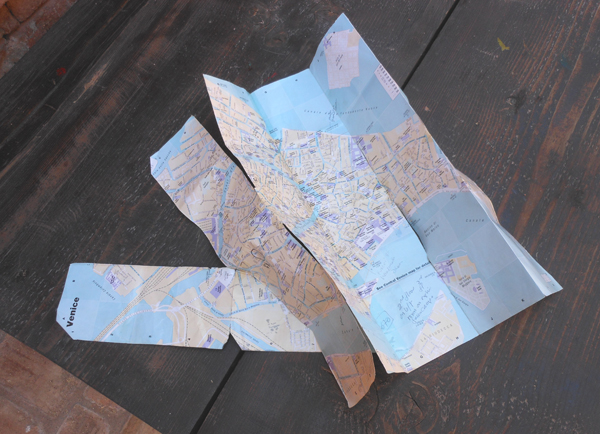
This is my trusty map of Venice after only two weeks here.  You should see it now.

Venice is a city of reflections.  It seems I'm always peering in or out of windows.  We're peeking into the oldest intact storefront in the city - a pharmacy with original wood fixtures and old apothecary bottles.  Because of Venice's access to ingredients from the far east, the city was a forerunner in the design and production of medicinals and curative potions.

A blue sketch I did when I first arrived at the Scuola di Grafica.

Look closely, and you'll see the UPS boat (it's more blue than brown!).  Shortly before seeing this, I spied a FedEx boat zooming down the Grand Canal.

And finally, I promised  you a blue pigeon.  This fellow was with a huge flock of ordinary-colored pigeons on Piazza San Marco.  Lorenzo, the director of the Scuola di Grafica, says it's a miracolo, and I would agree, because a few minutes later, I saw a bright orange one.

Arrivederci!  I'm off in search of secondary colors.  I think I'll start with ARANCIONE


Sunday, September 9, 2012

Earth, Fire and Water: VENICE

Some more jewels of GIALLO before we move on to BLU...

This is the view from the studio window of a terrace lived in by Domenico, chef extraoridinaire, of a restaurant where the artists frequently gather for lunch.

A stately reflection.

Although beautiful, this marble is turning to marshmallow, due, they say, to the pollution blowing in from the industrial north.

Richard Wagner lived his last winter (1882-1883) just around the corner from our studio in a palazzo called Vendramin Calergi.  Now, most of the palazzo is a casino, but a few rooms remain for the Museo Richard Wagner.

These are my favorite street musicians, playing in front of Billa, one of our grocery stores of choice.  The second day I arrived in Venice, they were playing a sublime, romantic piece, and drawing quite a crowd.  Swept up by the moment,  an older couple began to dance on the street, riveted to one another, as if there was nothing in the world but the music and each other. 

While waiting for La Traviata to begin at La Fenice opera house, I snapped a photo of the box seats.

San Marcuola is the campo where the Studio Internazionale di Grafica is located.  This sign points to a traghetto crossing.  Along the Canal Grande, there are many places you'd like to cross, but no bridge is nearby.  Traghettos are stripped-down gondolas that ferry you across the canal at crucial points for a mere 70 cents.

For those willing to spend much more than the cost of a traghetto or vaporetto, there are water taxi stops everywhere.  The taxi boats are very luxurious, and you hail them just as you would on the streets of Manhattan.

Venice has made well-traveled sections of town accessible to wheelchairs.  Here is an example, near San Marco, where a ramp has been added to a canal bridge.  Not a soul uses the stairs.

Believe it or not, this is the main entry to the Ospedale Civile, Venice's main hospital.

Here are the hospital ambulance bays with the ER just to the right.

A lovely canal in the Dorsoduro section of the city.

I love the variations of ochres on this building.

This is Campo San Maurizio and the view from my bedroom window.  The bell in the leaning campanile clangs on the 1/2 hour, starting at 7:30am and ending around 10:00pm.  It is the best alarm clock I have ever had the pleasure of using.

An elegant brass door handle.

Venice has bricks of many colors.  The yellow bricks seem particularly susceptible to erosion, and leave a powdery residue on the street below.
This view of a royal family of chimney pots is from the window of the Fortuny Museum. 
A group of us went to the Seguso glass-blowing furnaces for a night tour on the island of Murano.  Hanging among the furnaces were exquisite glass chandeliers.  Apparently they make copies of high-end commissions in case of loss or breakage over time.
The last post showed multi-colored "bulls eye" windows.  Here is a lovely example in yellow.
Yesterday, I came across an eccentric bookstore called Acqua Alta.  It overflowed with books old and new, post cards, maps and ephemera.  A complete gondola sat in the center of the store, full of books.  The owner told me to go to the back garden and here is what I found.  On the other side of the tiny walled terrace was a canal, so he built a stairway of books so that visitors could get a "beautiful view", which it was.  (You could also rest in the armchair built of books.)
BLU skies,  blu water and... blu pigeons?  Coming up next!